Billing & Invoicing Built Into the EMR
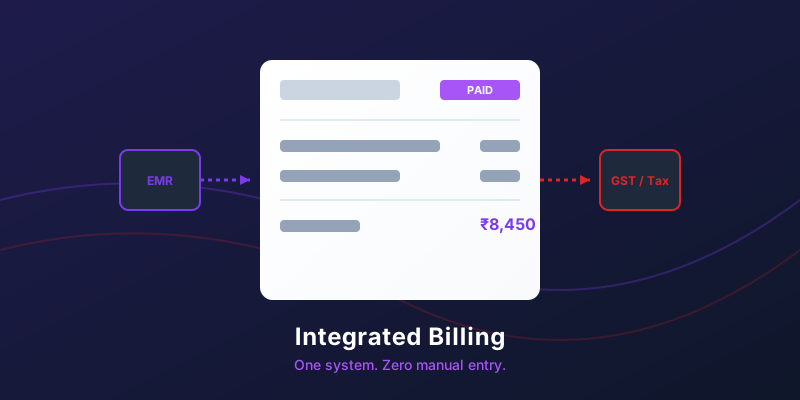
Separate billing software is costing your clinic time, money, and compliance headaches. Integrated EMR billing — where invoicing, payment tracking, and accounting live in one system — eliminates manual data entry, stops revenue leakage, and ensures GST compliance. Save ₹50,000+ annually and reclaim 8-10 hours per week.
01 · THE FRAGMENTATION TRAPWhy Three Systems Are Bleeding Your Clinic
Picture the billing workflow in most Indian clinics:
Doctor sees a patient. Consultation fee = ₹500. Prescribed tests, medicines, and follow-up. Doctor enters data in the EMR (or on paper, then staff enters it later). Later that day, billing staff pulls the record, opens a separate billing software, and manually re-enters the patient name, consultation fee, and procedure codes. That afternoon, an accountant opens Tally or QuickBooks and re-enters the same data again for GST invoicing and reconciliation.
Three entries. Three chances for error. Three systems that don't talk to each other.
- ✗ Data entered 3 times (EMR → Billing → Accounting)
- ✗ 26.8% of diagnoses incorrectly coded
- ✗ Procedures done but not billed = silent loss
- ✗ GST invoices don't match clinical notes
- ✗ Billing staff: 35-40 hours/week on manual tasks
- ✗ Monthly reconciliation: 2-3 days lost
- ✗ Revenue leakage: 15-20% of charges missed
- ✓ Data entered once, used everywhere
- ✓ Coding errors drop below 5%
- ✓ Every procedure auto-invoiced in real-time
- ✓ Invoices auto-sync with clinical data
- ✓ Billing staff: 15-20 hours/week, more strategic work
- ✓ Reconciliation: automatic, instant
- ✓ Revenue recovery: capture 95%+ of charges
The Four Hidden Costs
- → ① Silent Revenue Loss: Procedures done but not billed, missed charges, forgotten ancillary services. A busy clinic loses ₹20,000-₹50,000+/month.
- → ② Manual Entry Errors: 15-20% of claims rejected globally; 26.8% of diagnoses incorrectly coded in India. One typo triggers GST penalties or insurance denials.
- → ③ GST Chaos: Healthcare exempt, medicines taxable = split invoicing nightmare. Mismatched invoices = ₹25,000 penalties. Most clinics spend 2-3 days/month reconciling.
- → ④ Staff Burnout: Billing staff spend 35-40 hours/week on manual data entry across three systems. Low morale, high turnover, slow revenue cycles.
02 · HOW INTEGRATED BILLING SOLVES ITOne System, One Source of Truth
Doctor sees patient. Consultation, tests, medicines — all recorded in EMR during the visit. The system automatically generates a GST-compliant invoice in real-time based on what was done. The invoice separates taxable services (medicines, procedures) from exempt services (consultations, diagnostics). Payment tracked instantly — UPI, cash, card, or insurance. Reconciliation automatic. No re-entry. No errors. No lost time.
What Integrated Billing Does
- → Automated invoicing: Every consultation, procedure, medicine, test auto-generates a compliant invoice. No manual entry. No forgotten charges.
- → Real-time payment tracking: Cash, UPI, card, insurance — all tracked in one place. Patients see outstanding balance in portal.
- → GST compliance: System auto-separates exempt vs taxable services, applies correct GST rates and HSN/SAC codes. Zero compliance risk.
- → Instant reconciliation: All data entered once, used everywhere. Reconciliation is automatic and instant.
Time Savings: Billing staff reduce from 35-40 hours/week to 15-20 hours/week. That's 700-870 hours/year per staff member — equivalent to one extra full-time person redirected to patient care.
Revenue Recovery: By eliminating missed charges and ensuring every service is billed, integrated billing captures 95%+ of revenue. A clinic doing 30 consultations/day at ₹500 each + ₹200-₹500 ancillary could recover ₹1.25M-₹2.5M annually in previously lost revenue.
Integrated Billing Features
-
→ Automated invoice generation — triggered by consultations, procedures, medicine dispensal, or custom charges; all GST-compliant
-
→ Real-time payment tracking — cash, UPI, cards, insurance claims; patient portal shows outstanding balance
-
→ GST-compliant invoicing — automatically separates taxable vs exempt services; correct HSN/SAC codes; invoices sync with prescriptions and clinical notes
-
→ Payment reminders — WhatsApp notifications for unpaid invoices; patient portal for easy payment
-
→ Instant reconciliation — automatic cash flow reporting, outstanding receivables tracking, monthly revenue insights
-
→ Multi-payment support — integrates with UPI, card gateways, and insurance claim submission for Ayushman Bharat (PM-JAY) and other schemes
03 · INDIA-SPECIFIC CHALLENGESGST Complexity, Payment Chaos, Handwritten Invoices
GST Rules Are Complex. Healthcare services exempt, but medicines/implants taxable. A patient with one exempt consultation + taxable medicines needs split billing. Manual systems create reconciliation nightmares. Integrated billing auto-handles this split, ensuring correct GST per service.
Payment Methods Are Mixed. UPI dominates (85.5% of digital volumes), but cash remains significant. Clinics track UPI, cards, cash, and insurance claims. Separate systems fail here; integrated billing tracks all methods in real-time with automatic reconciliation.
Many Young Clinics Start with Handwritten Invoices. Fresh MBBS graduates start on paper or Excel. By month three, this breaks down: 90 patients with outstanding balances, no GST records, zero visibility. Starting with integrated EMR billing from day one prevents this chaos entirely.
Stop Losing Revenue to Fragmented Systems
Automated invoicing, real-time payment tracking, and GST-compliant billing — all built into one EMR.
Start Free Trial → Book a DemoTransform your practice today
Join thousands of modern clinics utilizing MedHive to automate and grow.
Book a Demo