Lessons Learned From Clinics That Successfully Went Digital
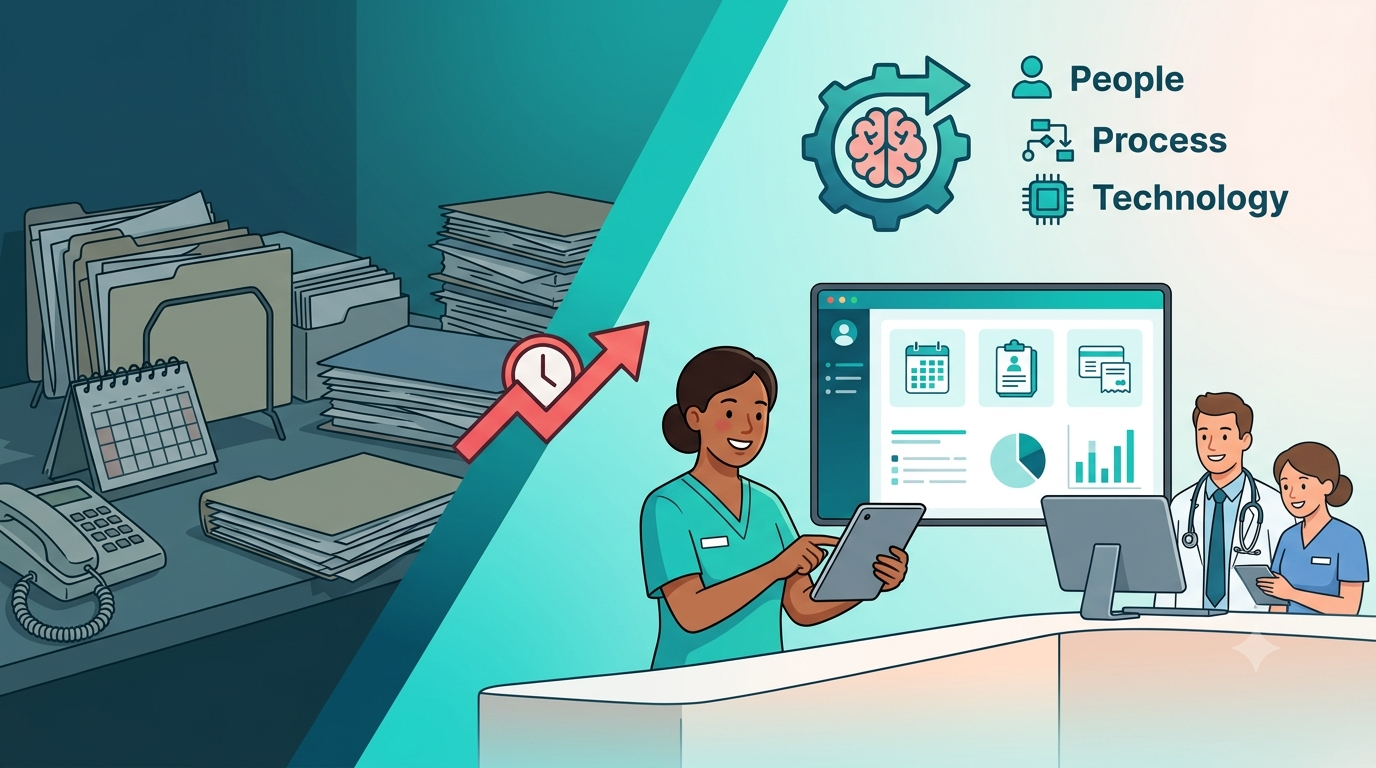
Most clinics that put off going digital aren't doing it out of stubbornness. They're doing it because they've heard the horror stories — the system nobody could figure out, the data migration that lost records, the three months of chaos before things settled down. That worry is fair. Digital transitions can absolutely go badly. But they don't have to, and the clinics where it went well weren't lucky. They made a small, consistent set of decisions that any practice can copy.
Those decisions tend to fall into three buckets: how they handled their people, how they handled their process, and how they chose their technology. None of the three works well alone — but together, they're the actual difference between a transition that sticks and one that gets quietly abandoned six weeks in.
THE CONTEXTWhy the Worry Is Reasonable
A clinic isn't a clean slate. There's an existing rhythm — staff who know the paper system blindfolded, patients used to a certain way of being checked in, a doctor who's built years of muscle memory around handwritten notes. Asking all of that to change at once, while the clinic keeps running, is genuinely hard. Practices that underestimate this difficulty are the ones who struggle most. The ones that succeed don't skip the difficulty — they plan around it.
PART 1Lessons in People
Technology doesn't fail clinics nearly as often as people problems do — resistance, confusion, or simply not being brought along for the decision.
They picked an internal champion before they picked a system
Successful clinics usually have one staff member — often not the most senior person — who learns the new system first and becomes the person others ask instead of getting frustrated alone. That single role does more for adoption than any training manual.
They explained the "why," not just the "how"
Staff who understand why a change is happening — fewer errors, less repeated work, faster end-of-day routines — adapt faster than staff who are just told to start using something new. The clinics that skip this step end up fighting quiet resistance for months.
They didn't assume everyone learns at the same speed
A younger staff member might be comfortable within days. A long-tenured staff member, set in their ways, might need weeks of patience. Clinics that succeed plan for the slowest learner, not the fastest.
What They Avoided
Rolling out the system to everyone at once with a single training session and no follow-up support.
What They Did Instead
Phased training, a designated go-to person, and patience built into the first month's schedule.
PART 2Lessons in Process
Even with the right people on board, a transition can stumble if the sequence of changes is wrong.
They didn't switch everything on the same day
Clinics that succeeded usually ran the new and old systems in parallel for a short stretch, or rolled out one function at a time — scheduling first, then records, then billing — rather than flipping every process over in a single weekend.
They migrated data carefully, not quickly
Old records, even messy ones, are the clinic's history. The clinics that handled this well treated data migration as its own project with its own checklist, rather than something to rush through in a weekend to "get it over with."
They picked a quiet week to start, not a busy one
Timing mattered more than most clinics expect. Starting right before a seasonal rush or a known busy period stacked a learning curve on top of already high pressure — a combination that made the change feel far worse than it needed to.
PART 3Lessons in Technology
The system itself matters too — but less for its feature list and more for how well it fits into a real working day.
They prioritized ease of daily use over a long feature list
A system with fifty features that nobody opens past the third one isn't actually helping. The clinics that got real value picked tools that handled the daily basics — scheduling, records, billing — smoothly, rather than the system with the most checkboxes on a brochure.
They made sure it worked the way the clinic actually worked
A solo doctor's workflow and a five-doctor clinic's workflow aren't the same. The clinics that succeeded picked tools flexible enough to match how they already operated, instead of forcing their workflow to bend around the software.
They treated support as part of the product, not an afterthought
When something goes wrong in week two — and something usually does — the difference between a five-minute fix and a half-day of frustration is almost entirely about how reachable and responsive support actually is.
This is exactly where MedHive was built to hold up:
- →Simple, guided scheduling that staff pick up in days
- →Structured patient records built around real clinic workflows
- →Built-in billing that closes the loop without a separate tool
- →A patient portal that doesn't need hand-holding to use
- →Role-based access for multi-doctor and growing clinics
- →Responsive support during the exact weeks it matters most
CONCLUSIONThe Thread Running Through All Three
Look closely at the lessons above and a pattern shows up: none of them are really about technology at all. They're about pace, communication, and choosing tools that fit real working life rather than an idealized one. The clinics that succeeded weren't the most tech-savvy ones in the room — they were the most deliberate ones.
Every clinic still on paper today has a version of the same fear: that switching will be the thing that finally breaks an already busy week. The clinics that got through it well didn't avoid that fear — they planned specifically around it, one deliberate decision at a time.
Frequently Asked Questions
What's the single biggest reason digital transitions fail in clinics? +
More often than not, it's people-related — staff who weren't brought along on the "why," or a rollout that asked everyone to adapt at the same speed at the same time.
Should a clinic switch everything to digital at once, or in stages? +
Staged is almost always safer. Clinics that succeeded typically moved one function at a time — scheduling, then records, then billing — rather than flipping every process over in a single weekend.
How important is choosing the "right" software versus how it's rolled out? +
Both matter, but rollout tends to matter more in practice. A good system poorly introduced can still fail; a decent system introduced thoughtfully, with patience and a clear champion, tends to succeed.
What's a good time to start a digital transition? +
A comparatively quiet period, not a busy or seasonal one. Starting during a known rush stacks a learning curve on top of pressure that's already high.
How long does it typically take for a clinic to feel settled in a new digital system? +
Most clinics report the first few weeks as the hardest, with day-to-day comfort improving steadily over the following one to two months as staff build familiarity.
Make Your Transition One of the Success Stories
MedHive is built around the lessons above — simple enough for staff to adopt fast, flexible enough to fit how your clinic actually works. Book a walkthrough and see it for yourself.
Transform your practice today
Join thousands of modern clinics utilizing MedHive to automate and grow.
Book a Demo