Security That Meets India's New Standards
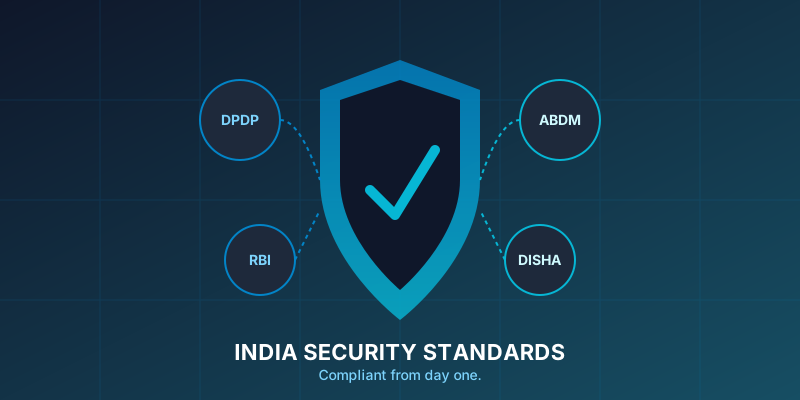
India's healthcare sector is regulated. DPDP Act 2023 is now effective. RBI payment security rules are tightening. ABDM digital health standards are mandating clinic adoption. A data breach costs ₹17.9 crore. Regulatory penalties reach ₹250 crore. And most clinics don't know which laws apply to them. Here's the complete picture and how to meet every standard.
01 · THE COMPLIANCE LANDSCAPEFive India Standards You Must Know
India has no single healthcare data law. Instead, clinics must navigate five overlapping regulatory frameworks, each with different requirements:
Why Compliance Audits Fail
Most Indian clinics fail health authority audits because they're missing three things: data localization proof (servers in India, not cloud abroad), access controls (audit logs showing who accessed patient data and when), and encryption verification (AES-256 at rest, TLS in transit). Auditors also check for incident response plans, patient consent documentation, and data protection officer (DPO) appointment. Without these, clinics face operational restrictions, closure orders, or heavy fines.
02 · HOW MEDHIVE MEETS ALL STANDARDSBuilt-In Security, No Compromise
MedHive's architecture ensures compliance out of the box:
① Data Localization (DPDP + RBI + DISHA)
All patient records, payment data, and personal information stored in Indian data centers. No foreign cloud. No offshore processing. You get physical proof of localization for audits: server location certificates, data residency reports, and infrastructure maps showing India-only storage. DPDP compliance. RBI compliance. DISHA-ready.
② Encryption at Three Levels
- → At Rest: AES-256 encryption for all stored data (patient records, payments, consent logs)
- → In Transit: TLS 1.3 for all data moving between clinic, server, and third-party systems
- → End-to-End: Sensitive fields (SSN, Aadhaar, payment details) encrypted even within the EMR
③ Access Controls & Audit Logs
Every staff member gets role-based permissions: doctors access clinical data, billing staff access invoices, reception accesses demographics. Each data access is logged with timestamp, user ID, and action taken. Auditors can instantly verify: "Who accessed this patient record? When? For what purpose?" Compliance ready. Breach traceable.
④ Patient Consent Management
Explicit consent captured at registration: "I consent to my data being used for treatment, billing, and ABDM sharing." Patients can withdraw consent anytime. Consent status visible in real-time. Complies with DPDP Act right to consent, IT Act doctor-patient confidentiality, and ABDM interoperability rules.
⑤ Incident Response & Breach Reporting
Built-in breach detection: unusual data access flagged automatically. Incident response plan embedded in workflows. Breach reporting to authorities automated. No scrambling. No missed deadlines. DPDP Act requires breach notification within 72 hours; MedHive's system ensures it.
Compliance Across All Five Standards
-
→ DPDP Act: Encryption, access controls, consent management, audit logs, incident response, DPO support
-
→ ABDM/NDHM: FHIR-compliant APIs, interoperability ready, ABHA integration, consent-driven data sharing
-
→ RBI Payment Security: India-only data storage, two-factor authentication built-in, PCI DSS compliance for card data
-
→ DISHA (Proposed): Data localization proof, encrypted storage, audit trails for regulatory submission
-
→ India IT Act: Doctor-patient confidentiality enforced, confidentiality agreements automated, Medical Council regulation alignment
03 · TWO REAL SCENARIOSHow Growing Clinics Stay Compliant
Scenario 1: Single Doctor → Five Doctors (Clinic Scaling)
A fresh MBBS graduate starts a clinic with paper records. Month 3: 100 patients, zero compliance documentation. Month 6: Audit notice arrives. Health authority checks: "Where are your access logs? Encryption certificates? Patient consent records?" Paper clinics have none.
By switching to MedHive before scaling, the same doctor avoids this crisis. Every new patient auto-generates a consent record. Every staff member gets logged access. Every lab result is encrypted. By the time the clinic hits 5 doctors, 500 patients, and health authority audit, all documentation is ready. Audit passes. No delays. No penalties.
Scenario 2: Multi-Specialty Hospital Standardizing Security
A 20-bed multi-specialty hospital uses three different EMRs (cardiology, orthopedics, pathology). DPDP compliance is fragmented. Payment data stored in different systems. Audit risk is high.
Consolidating onto MedHive means: unified data localization (one India server, all departments), unified access controls (cardiologist can't access orthopedic records), unified compliance documentation (one DPO, one audit trail). Result: hospital becomes audit-ready instantly. Risk drops. Compliance costs fall. Patient trust rises.
Audit-Ready Security, Starting Today
Meet DPDP Act, ABDM, RBI, DISHA, and IT Act requirements without complexity. MedHive handles encryption, access controls, consent, and compliance documentation automatically.
Start Free Trial → Book a Security AuditTransform your practice today
Join thousands of modern clinics utilizing MedHive to automate and grow.
Book a Demo