Why Small Clinics Are Adopting Digital Systems Faster Than Ever
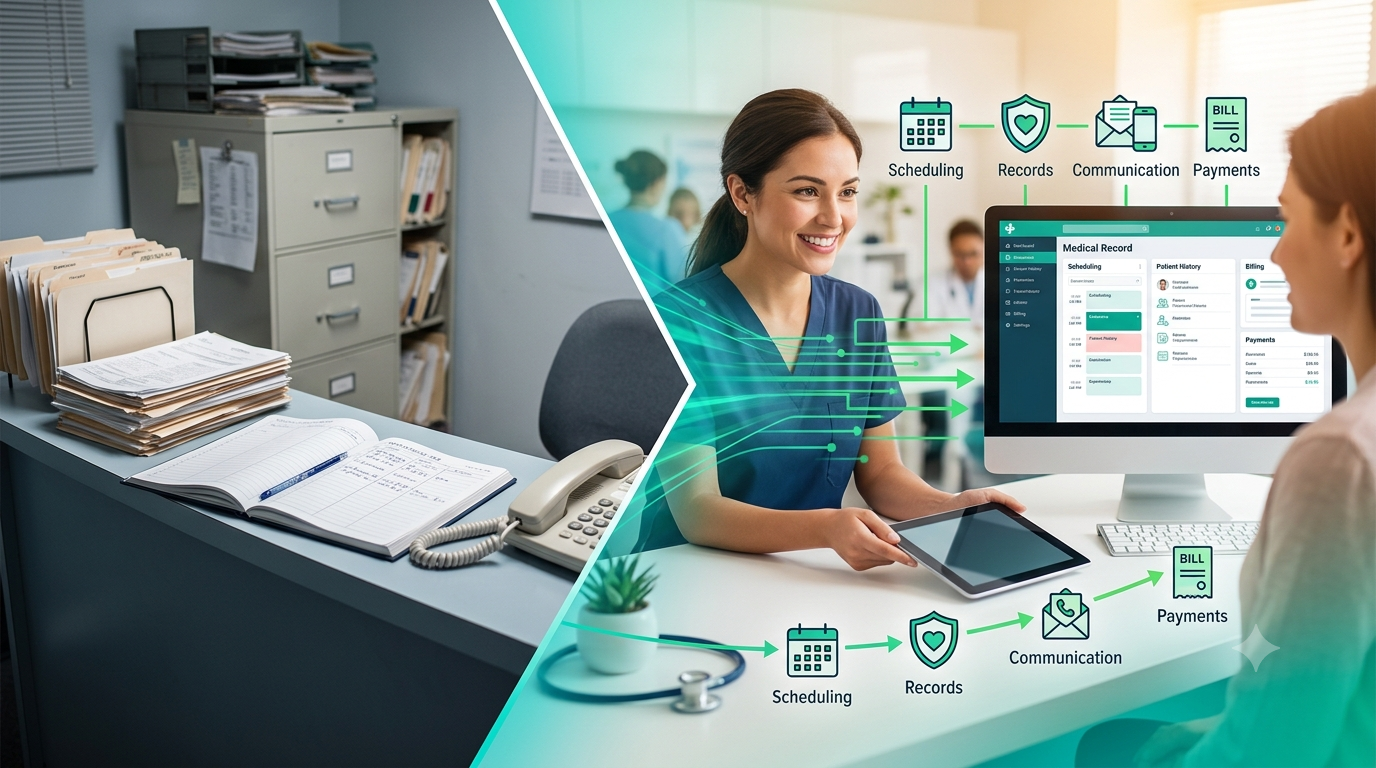
Small clinics and solo practices are adopting digital systems at a pace that would have seemed unlikely just a few years ago. Not because of a mandate, and not because the technology suddenly got smarter — but because the gap between clinics that have gone digital and clinics that haven't has become impossible to ignore, for owners and patients alike.
01 · THE WHY-NOWThree Forces Pushing Small Clinics Online
Digital adoption among small clinics isn't happening because of one big push. It's the result of three separate pressures converging at the same time, each reinforcing the other.
① Patient expectations have quietly reset
Patients now book a haircut, a cab, and a table at a restaurant from their phone without thinking twice. When the same patient calls a clinic and has to wait on hold to book an appointment, or shows up to find their previous visit notes nowhere to be found, the contrast is jarring. Patients aren't demanding cutting-edge technology — they're expecting the same baseline convenience they already get everywhere else.
② Falling behind is now visible, not theoretical
A few years ago, a clinic without a digital system simply looked the same as every other clinic. Today, the clinic down the street that sends appointment reminders, lets patients book online, and pulls up a full history in seconds stands out — and patients notice. For a solo doctor competing for the same patient pool, that gap shows up directly in who walks through the door.
③ The technology finally caught up to small practices
Digital health systems used to be built for large hospitals — expensive, complex, and requiring dedicated IT staff to run. That's no longer the baseline. Modern EMRs are built specifically for solo doctors and small teams, priced and designed for clinics with one front desk, not a 50-person admin department. Combined with near-universal smartphone and internet access, even small-town clinics can now run a fully digital practice without specialized infrastructure.
02 · THE MYTH"My Clinic Is Too Small to Need This"
"I only see a handful of patients a day — a full digital system is overkill for a clinic my size."
This is the single biggest reason small clinics delay going digital, and it's based on an outdated picture of what these systems were built for.
Digital systems weren't built for hospital scale and scaled down — modern EMRs are built for exactly this size of practice. A solo doctor seeing 20 patients a day has no admin team to absorb manual scheduling, paper filing, or billing errors. That makes a simple system more valuable for a small clinic, not less, because there's no buffer of extra staff to catch what falls through the cracks.
The clinics that wait for "enough scale" to justify going digital usually find that the disorganization they were trying to avoid arrives well before the scale does.
03 · OLD WAY VS NEW WAYWhat Actually Changes Day to Day
The difference between a paper-based clinic and a digital one isn't abstract — it shows up in concrete, everyday moments for both staff and patients.
- ×Patient history scattered across notebooks and memory
- ×Appointments booked by phone, tracked on paper
- ×No reminders — patients forget, slots sit empty
- ×Billing calculated and recorded by hand
- ×Prescriptions handwritten, sometimes hard to read
- ×No easy way to follow up after a visit
- ✓Full patient history available in seconds, every visit
- ✓Patients book online or get instant confirmation
- ✓Automated reminders cut down missed appointments
- ✓Billing generated automatically, fewer errors
- ✓Prescriptions typed, clear, and stored with the record
- ✓Follow-ups sent automatically via message
04 · WHERE IT SHOWS UPFive Areas Going Digital First
Clinics rarely digitize everything at once. In practice, these five areas tend to move first, because they're where the old manual habits cause the most friction.
Every visit, prescription, and note in one searchable place — no more flipping through old files mid-consultation.
Online booking and automated reminders replace phone tag and forgotten appointments.
Invoices generated automatically from the visit, reducing manual calculation errors and payment delays.
Reminders, follow-ups, and reports delivered straight to a patient's phone instead of relying on them to call back.
Digital prescriptions are legible by default and link directly to lab results, instead of living on separate paper trails.
One System, Not Five Separate Habits
Most small clinics don't need five different tools bolted together — they need one system that handles records, scheduling, billing, communication, and prescriptions as a single connected workflow. That's the gap MedHive is built to close for solo doctors and small teams.
- →Unified patient records — full history available instantly at every visit
- →Built-in scheduling & reminders — online booking with automated WhatsApp follow-ups
- →Integrated billing — invoices generated directly from the consultation
- →Digital prescriptions — clear, stored, and linked to the patient record automatically
- →Set up in days — designed for small teams, not hospital IT departments
05 · WHAT THIS MEANSThe Window to Wait Is Closing
None of this means a clinic without a digital system today is behind for good. But the gap between digital and non-digital clinics is widening, not narrowing, and it's patients — not regulators or competitors — who are driving that gap. Every patient who experiences a smooth, digital clinic visit recalibrates what they expect from the next one.
For a solo doctor or small clinic owner, the question is no longer whether to go digital, but when — and the clinics moving now are doing so while the transition is still relatively easy, before the patient base and daily volume make switching systems a much bigger undertaking.
Frequently Asked Questions
Is my clinic too small to need a digital system? +
No. Digital systems were once built for large hospitals, but modern EMRs are designed specifically for solo practices and small clinics. A one-doctor clinic seeing 20 patients a day benefits from organized records and automated reminders just as much as a larger practice, often more, since there's no admin team to absorb the manual workload.
Why are small clinics adopting digital systems faster now than before? +
Three forces are converging: patients now expect WhatsApp reminders and online booking as a baseline, clinics that have gone digital are visibly pulling ahead on patient experience, and smartphone and internet access has made digital tools practical even in smaller towns where they weren't viable a few years ago.
What's the real difference between a paper-based clinic and a digital one? +
The clearest difference shows up in patient experience: faster check-ins, no lost records, automated appointment reminders, and instant access to history during a consultation. Behind the scenes, the clinic also saves staff time, reduces billing errors, and gets a clearer picture of what's working.
Is switching to a digital EMR complicated for a small clinic? +
Modern EMRs built for small practices are designed to be set up in days, not months, with minimal staff training. The complexity that existed with older hospital-grade systems doesn't carry over to tools built specifically for solo doctors and small teams.
What should a small clinic look for when choosing a digital system? +
Look for a system that covers patient records, scheduling, billing, and communication together rather than as separate disconnected tools, is simple enough for existing staff to use without lengthy training, and can grow with the clinic rather than needing to be replaced later.
See What a Connected Clinic Looks Like
Records, scheduling, billing, and communication — running as one system, set up in days. Built for solo doctors and small teams.
Transform your practice today
Join thousands of modern clinics utilizing MedHive to automate and grow.
Book a Demo