Smart Registration: How the Right EMR Ends the New-Patient Form Nightmare
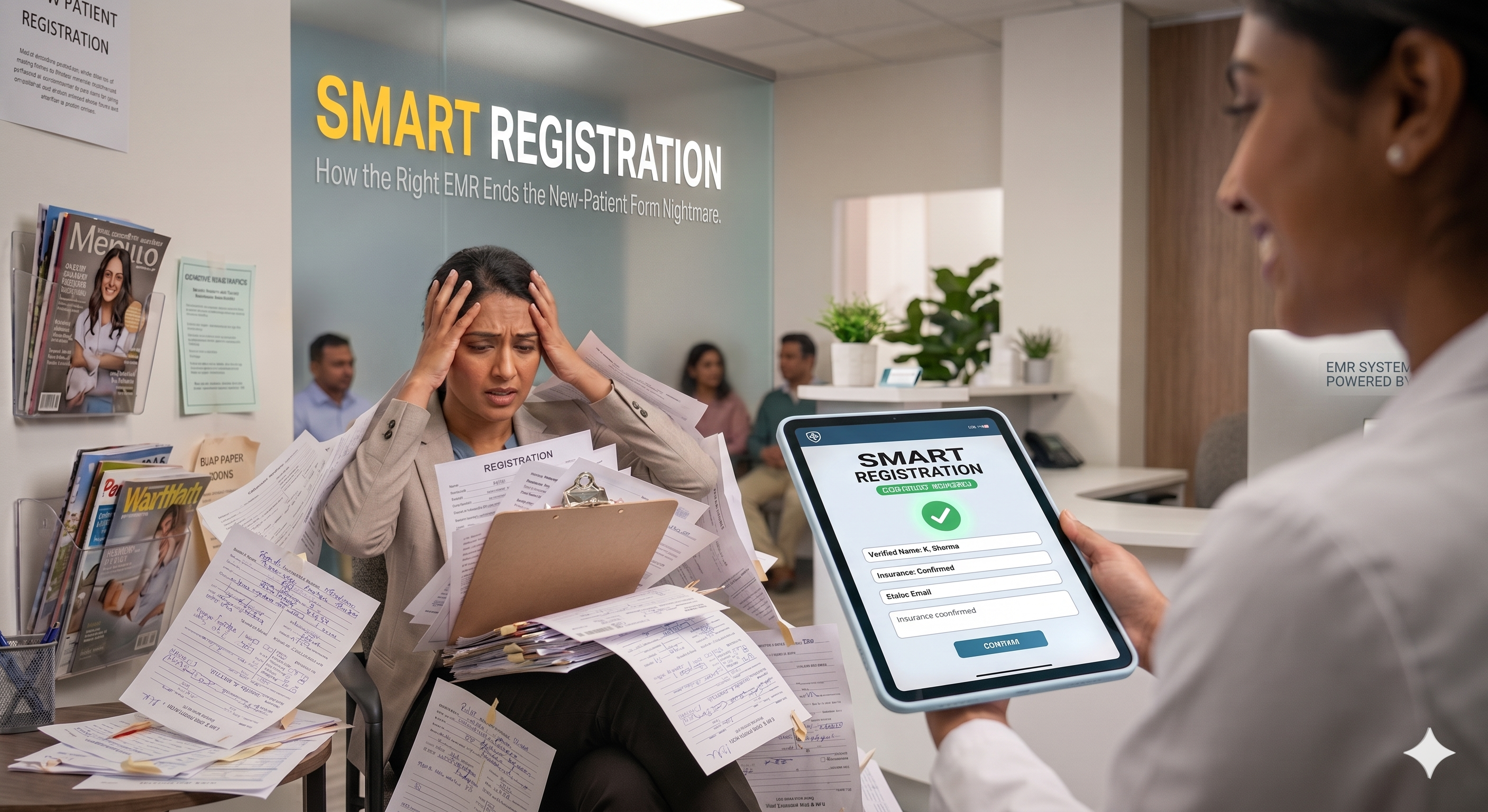
Walk into almost any clinic in India today and there's a good chance you'll be handed a paper form — even if you were there last month, last week, or yesterday. Patient registration is the most repeated, most error-prone, and most overlooked step in clinical operations. It's also the one that smart EMRs are quietly revolutionising.
01 · THE PROBLEMWhy Repetitive Registration Is Costing Clinics More Than They Realise
It seems like a minor inconvenience. A patient fills out their name, age, address, and contact number. Again. But the ripple effects compound quickly — and they hurt clinics in ways that rarely show up on a revenue report.
Consider what happens when a patient's phone number is entered differently each visit — maybe a digit is off, or the country code is added once but not again. You now have two patient records. When a lab report arrives, it attaches to the wrong one. The doctor makes a clinical decision missing critical history. This isn't a hypothetical; it's a daily reality at thousands of Indian clinics still running on manual or outdated systems.
02 · WHAT SMART REGISTRATION ACTUALLY MEANSMore Than Just Going Paperless
Digitising a paper form is not smart registration. It's just a paper form on a screen. True smart registration is defined by three capabilities working in concert:
1. Instant Patient Recognition
The moment a returning patient gives their name or number at the front desk, the system should surface their complete record — verified, up-to-date, and ready. No typing, no searching through a ledger, no duplicate risk. The receptionist confirms identity and moves on. The entire check-in for a returning patient should take under 60 seconds.
2. Pre-Visit Digital Intake
For new patients, smart registration means the form is completed before they even walk in the door. A pre-registration link sent via WhatsApp or SMS allows patients to fill in their details at home, on their commute, or in the waiting area — on their own device, in their own time. By the time they arrive, their record already exists. The front desk simply verifies and confirms.
3. One Patient Master Across All Touchpoints
A patient's record shouldn't change depending on which branch of your clinic they visit, or which staff member creates it. Smart registration systems maintain a single canonical patient profile — one source of truth — that is updated incrementally rather than recreated on every visit.
📍 Smart Registration Flow
03 · THE INDIA CONTEXTWhy This Is Especially Critical for Indian Clinics
Indian clinics face a set of registration challenges that are uniquely local — and largely unaddressed by legacy systems designed for Western healthcare workflows.
- High volumes with lean staff — a single-doctor clinic in a Tier 2 city might see 80 patients a day with one receptionist. Every second of efficiency is amplified.
- Multi-branch operations — patients don't always return to the same branch. A patient who visited your Adyar clinic last month shouldn't be treated as a new patient when they walk into your Velachery branch today.
- Mixed literacy and tech comfort — pre-registration forms must work across age groups, languages, and device types, including older Android phones on slow connections.
- ABHA integration — India's Ayushman Bharat Health Account (ABHA) system provides a unique 14-digit health ID for every citizen. Smart registration systems that can verify and link ABHA IDs are building a future-proof patient identity layer that goes beyond any single clinic's records.
- DPDP Act compliance — under India's Digital Personal Data Protection Act 2023, consent for collecting patient information must be explicit, documented, and revocable. Smart registration isn't just convenient — it's now a legal architecture question.
04 · OLD WAY VS NEW WAYWhat Changes When You Get Registration Right
| Scenario | Old Way | Smart Registration |
|---|---|---|
| Returning patient checks in | Fill form again, re-enter details manually | Auto-load record, confirm in one click |
| New patient first visit | Paper form at reception, staff re-types into system | Digital intake on patient's phone before arrival |
| Patient visits different branch | Treated as new, duplicate record created | Single patient master — same record everywhere |
| Patient spells name differently | New duplicate record created | Mobile number or ABHA ID as primary identifier |
| Front desk busy, queue forming | Data entry backlog, patients wait longer | Pre-registration means no queue bottleneck |
| DPDP consent documentation | Paper signature, unstructured, hard to audit | Digital consent captured, timestamped, stored |
05 · HOW MEDHIVE DOES ITSmart Registration in MedHive — Under the Hood
MedHive was designed from the ground up for the Indian clinic environment. Registration isn't an afterthought — it's the foundational layer that every other module is built on top of.
How MedHive Handles Patient Registration
Here's what happens the moment a patient's name is entered at the MedHive front desk:
- Instant record lookup by mobile number — the primary identifier. No ambiguity from name spelling variations.
- Smart duplicate detection — before creating any new record, MedHive checks across the clinic's entire patient database, including all branches, for potential matches. Staff are prompted to merge or confirm rather than create blindly.
- Pre-registration via WhatsApp link — appointment confirmation messages include a one-tap intake link. New patients arrive with their record already built; returning patients arrive with their details pre-confirmed.
- One patient master, all branches — the same patient ID and clinical history is accessible across every branch of the clinic from a single login.
- ABHA ID linking — MedHive supports optional ABHA ID capture at registration, enabling integration with India's national health ecosystem.
- Consent capture built-in — digital consent for data collection is captured and timestamped at registration, fulfilling DPDP documentation requirements without extra steps.
The result at the front desk is remarkably simple: the receptionist types a phone number, the patient's record appears, they confirm it's correct, and check-in is done. For new patients who've pre-registered, it's the same — confirm and done. For walk-ins, the intake form takes three minutes on their phone while they sit in the waiting area.
06 · WHAT TO LOOK FOREvaluating Smart Registration in Any EMR
If you're comparing EMR platforms, here's a practical checklist for evaluating how seriously they take registration:
Smart Registration Evaluation Checklist
CONCLUSIONRegistration Is Where Trust Begins
Every patient's experience of your clinic begins not with the doctor — it begins at registration. A frustrating, repetitive front desk says something about a clinic whether it intends to or not. Conversely, a patient who checks in seamlessly, whose history is already on the doctor's screen, and who never has to repeat themselves, feels cared for from the first second.
Smart registration isn't a technology upgrade. It's a promise to your patients: we remember you, we value your time, and we're ready for you.
That's what the best EMR platforms make possible — and it's what MedHive™ was built to deliver for every clinic in India, regardless of size or specialty.
See Smart Registration in Action
Watch MedHive auto-load a returning patient in under 30 seconds — live demo, no commitment required.
Start Your Free Trial →Transform your practice today
Join thousands of modern clinics utilizing MedHive to automate and grow.
Book a Demo