Why Every Growing Clinic Needs Standardized Workflows
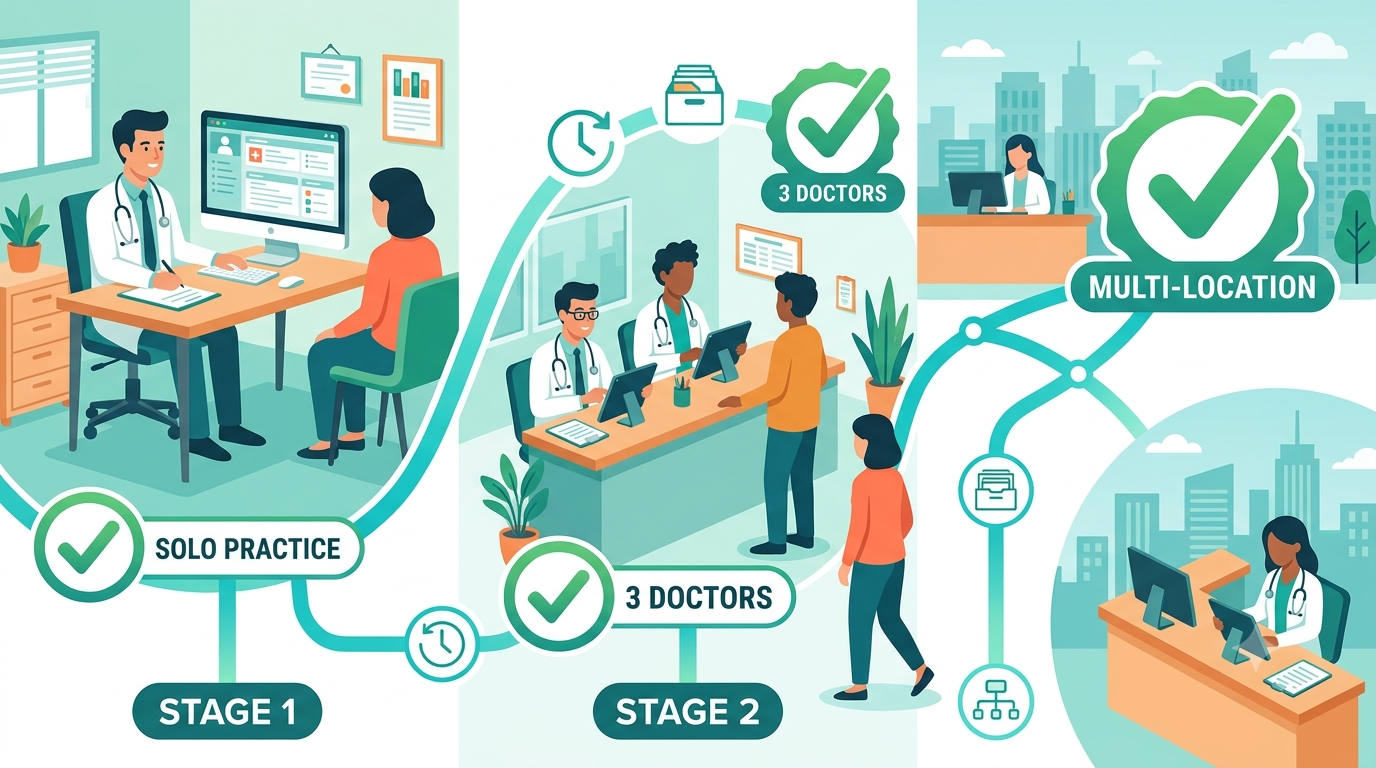
Nobody sets out to build a chaotic clinic. It happens gradually — one more doctor here, one more front-desk hire there, a second branch that seemed like a natural next step. Each individual decision feels manageable. It's only later, when two staff members are doing the same task two completely different ways, that the cost of never having written anything down becomes obvious.
That cost has a name: the absence of standardized workflows. And while it's tempting to treat this as a "later" problem — something to fix once the clinic is bigger and has more time — the truth is that the workflows a clinic builds at one doctor are the same ones that either bend gracefully or snap loudly as that clinic grows.
What Growth Actually Feels Like
From the inside, growing a clinic rarely feels like a single decision to "scale up." It feels like a string of small, reasonable additions — a second doctor to handle demand, a new front-desk hire because the first one can't keep up alone, a second location because the first one is full most afternoons. Each step makes sense on its own. What's easy to miss is that every one of those additions also multiplies the number of ways the same task can quietly start being done differently by different people.
STAGE 1The Solo Doctor
Everything lives in one person's head — and that's fine, until it isn't
At this stage, the doctor often is the workflow. They know which patients need extra time, which forms matter and which don't, and how billing should be handled, because they're the one doing all of it. This works, and it's tempting to assume it'll keep working as the clinic grows.
The risk at this stage isn't visible yet — it's stored up. Every shortcut, every "I just remember how I like to do it" habit, is a workflow that exists only in one person's memory. The moment a second person joins, even briefly, there's nothing written down to hand them.
STAGE 2Three Doctors
This is usually where the cracks become visible
With three doctors, three different personal styles are now operating side by side. One doctor documents thoroughly; another keeps notes brief. One front-desk staffer books follow-ups a certain way; another does it differently. None of these differences are anyone's fault — they're simply what happens when there's no shared standard, only individual habit.
This is also the stage where patients start to notice inconsistency directly — a different experience depending on which doctor or which staff member they happen to get that day. And internally, it's the stage where handoffs between staff start needing extra clarification calls just to confirm "wait, how did you want this done?"
STAGE 3Multiple Locations
Without a shared standard, growth doesn't multiply success — it multiplies the inconsistency
A second location doesn't just add more patients and more staff. It adds an entire second version of every workflow that was never standardized in the first place — its own way of billing, its own way of recording visits, its own informal rules. Without a shared system, the clinic isn't really one clinic anymore; it's two clinics that happen to share a name.
This is also the stage where the cost stops being just operational annoyance and starts becoming a real business risk — inconsistent records across locations make audits harder, ownership of patient data murkier, and the owner's ability to actually see what's happening across the whole practice much weaker.
It's worth being direct about one thing: standardization doesn't mean rigidity. A good standardized workflow still leaves room for clinical judgment — what it removes is the unnecessary variation in the parts of the process that should be identical every time, like how a record is structured, how a bill is generated, or how a follow-up gets scheduled.
Signs You've Outgrown Ad-Hoc Workflows
A few reliable signals that it's time to put a shared standard in place, regardless of exactly how many doctors or locations a clinic has:
- • Two staff members would describe "how we do X" in genuinely different ways.
- • New hires take longer than expected to get up to speed, because there's nothing written down to train them with.
- • The same question — "wait, how did you want this handled?" — keeps coming up between staff.
- • Patients occasionally comment that their experience felt different on a different visit or with a different staff member.
- • The owner can't quickly answer a basic question about what's happening across the whole practice without calling around.
- • A second location feels like starting from scratch rather than simply replicating what already works.
Growth is, by definition, more people doing more things. A standardized workflow is simply what makes sure all of that activity adds up to one consistent clinic, instead of several slightly different ones operating under the same name.
Frequently Asked Questions
Is standardization really necessary for a solo-doctor clinic, or only once there's a team?
It matters from day one. A solo doctor's workflow, once documented, becomes the foundation every future hire and location can build on — rather than something that has to be reconstructed later from memory.
What's the first workflow a growing clinic should standardize?
Scheduling and patient records tend to have the most immediate impact, since nearly every other workflow — billing, follow-ups, reporting — depends on them being consistent first.
Does standardizing workflows limit a doctor's clinical judgment?
No — standardization applies to the structural parts of a workflow, like how a record is formatted or how a bill is generated. Clinical decisions remain entirely the doctor's own judgment.
How does standardization make opening a second location easier?
A standardized workflow can be replicated directly at a new location, since staff are trained on a documented process rather than each location inventing its own version from scratch.
Can an EMR system actually enforce standardized workflows, or does that depend entirely on staff habits?
A well-structured EMR makes the standard the path of least resistance — entering a record, generating a bill, or scheduling a follow-up the same way every time simply because that's how the system is built, rather than relying on staff memory alone.
Transform your practice today
Join thousands of modern clinics utilizing MedHive to automate and grow.
Book a Demo