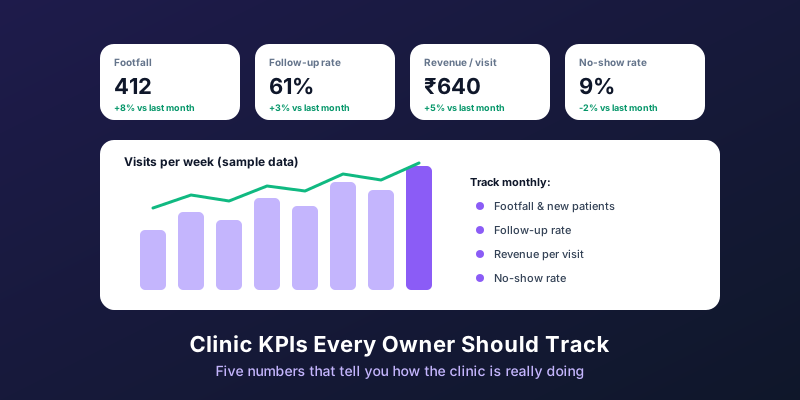
Most clinic owners know roughly how busy they were last month. Far fewer know how many new patients came back, how many follow-ups were missed, or what an average visit actually earned. A handful of numbers, checked once a month, answers those questions. This guide explains which metrics to track, how to calculate each one, and what to do when a number moves.
Why Monthly, and Why a Short List
Daily numbers in a clinic are noisy. A rainy Tuesday or a festival week tells you little. A month smooths that out while still being short enough to act on. Keep the list short too: six or seven numbers you actually review beat a thirty-line report nobody opens.
The most useful comparison is your own clinic against itself: this month against last month, and against the same month last year. There is no reliable public benchmark for an "average" Indian clinic, and your speciality, location and fee structure matter more than any national figure.
Patient Volume: Footfall, New and Returning
- Total visits: every completed consultation in the month, walk-ins included.
- Unique patients: how many different people those visits came from.
- New patients: first-ever visits to the clinic.
- Returning patients: unique patients minus new patients.
Read these together. Rising visits with flat new patients means your existing patients are coming more often. Rising new patients with falling returns may mean people are not coming back after a first visit, which is worth asking about. For new patients, also record how they heard about you, so you know which channels work.
Follow-Up Adherence Rate
This is the metric most clinics do not track and should. When a doctor asks a patient to return on a date, does the patient come?
Follow-up adherence = follow-ups completed within a reasonable window of the due date ÷ follow-ups that fell due in the month × 100.
Agree on a window, say up to a week after the due date, and use it consistently. A falling rate usually points to reminders not going out, or follow-up dates being given verbally and never recorded. For chronic patients this number matters clinically as well as commercially; our post on managing chronic patients explains why.
No-Show and Cancellation Rate
No-show rate = booked appointments where the patient neither came nor cancelled ÷ total booked appointments × 100. Track late cancellations (for example, within 24 hours) separately.
Leave walk-ins out of the denominator, or the rate will look better than it is. Break it down by doctor, day of week and time slot: no-shows often cluster in particular slots. Reminders and easy rescheduling are the usual fixes; see our post on scheduling and no-shows.
Revenue per Visit and Collections
- Revenue per visit = total billed revenue ÷ total visits. Split it into consultations, procedures, pharmacy and lab if you offer them.
- Collection rate = amount actually collected ÷ amount billed × 100. A gap means unpaid or written-off bills.
- Discounts and waivers as a share of billed revenue, by staff member if several people can give them.
- Expenses against revenue: rent, salaries, consumables and utilities, so you see the margin and not just the top line.
A worked example, with made-up figures: if a clinic billed ₹3,00,000 across 600 visits, revenue per visit is ₹500. If it collected ₹2,85,000, the collection rate is 95%. The point is not the figure itself but how it moves month to month. Revenue per visit should never become a target that pressures doctors towards extra tests or procedures; treat it as a check on billing accuracy and pricing, not clinical decisions.
Unbilled procedures are a common leak. Our post on billing built into the EMR explains how linking the visit to the invoice closes it.
Waiting Time and Doctor Utilisation
- Average wait: time from token or check-in to the start of consultation. Patients notice this more than almost anything else.
- Utilisation: booked or consulted time ÷ the doctor’s available hours. Low utilisation in certain sessions may justify changing hours; very high utilisation with long waits suggests the schedule is overbooked.
- Visits per doctor in a multi-doctor clinic, to balance workload rather than to rank colleagues.
Building a One-Page Monthly Review
Put the numbers on a single page with three columns: this month, last month and the same month last year. Then spend thirty minutes on it with your senior staff, and for each number that moved noticeably, agree one action and an owner. Examples:
- Follow-up adherence fell: check that follow-up dates are being entered and reminders are sending.
- No-shows rose on Saturday mornings: send an extra reminder for those slots, or open them to walk-ins.
- Collection rate slipped: review outstanding bills weekly instead of monthly.
The hard part is usually gathering the data, not reading it. If visits, bills and appointments sit in separate registers, the review takes a day. MedHive Pro’s reports cover revenue, expenses, tax, appointments, doctor statistics, attendance and patient demographics from the same system the front desk already uses, so the page can be built in minutes. Plan details are on the pricing page.
Frequently Asked Questions
What is a good no-show rate for a clinic?
It varies too much by speciality, city and booking pattern for one number to be meaningful. Measure your own rate consistently and aim for steady improvement.
Can I track this on a spreadsheet?
Yes, if visits, appointments and bills are entered reliably. The risk is that the spreadsheet depends on one person and drifts from reality. Software that records these as part of the day’s work is easier to keep accurate.
Should I share these numbers with staff?
Sharing operational numbers such as waiting time, no-shows and follow-up adherence helps staff see the effect of their work. Keep individual revenue figures between partners.
Your Monthly Numbers, Without the Spreadsheet
MedHive Pro builds reports from the appointments, visits and bills your team already records.