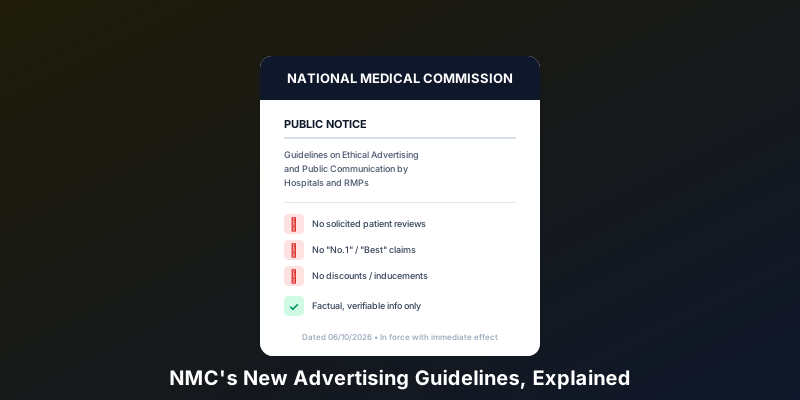
On October 6, 2026, the National Medical Commission quietly published a notice that changes how every clinic, hospital, and doctor in India is allowed to market themselves — online and offline, effective immediately. If your clinic has ever asked a happy patient for a Google review, run a birthday discount campaign, or put "Rank #1" on a flyer, this notice is worth reading in full.
The Guidelines on Ethical Advertising and Public Communication by Hospitals/Medical Institutions and Registered Medical Practitioners (Notice No. R-13014/01/2024-Ethics) were issued by the NMC's Ethics & Medical Registration Board, signed by Secretary Dr. Raghav Langer, and came into force the same day they were signed — no grace period, no phased rollout. Here's what's actually in them.
Why Now: The Backstory
The guidelines were framed in view of a Writ Petition (Civil) pending before the Supreme Court of India, and operate alongside the existing Indian Medical Council (Professional Conduct, Etiquette and Ethics) Regulations, 2002. The NMC states the objectives plainly: preserve the dignity of the medical profession, prevent commercialization of healthcare, protect patients from misleading claims, and regulate advertising on digital and emerging platforms — social media, WhatsApp, influencer marketing, AI-generated content, and "online healthcare platforms" are all explicitly named.
What Counts as "Advertisement" Now
The definition is deliberately broad. An "advertisement" is any communication, promotion, publicity, announcement, or dissemination of information, in any medium, that directly or indirectly solicits or promotes an RMP's or institution's services, reputation, skills, or facilities. The guidelines explicitly list digital, social-media, sponsored, targeted, influencer-led, search-engine, platform-based, and AI-generated or AI-assisted content as falling under this definition. Plain informational discourse with no promotional intent and no commercial benefit is exempt — but the bar for what counts as "promotional" is set low.
What's Now Prohibited
Patient reviews and testimonials, solicited or not
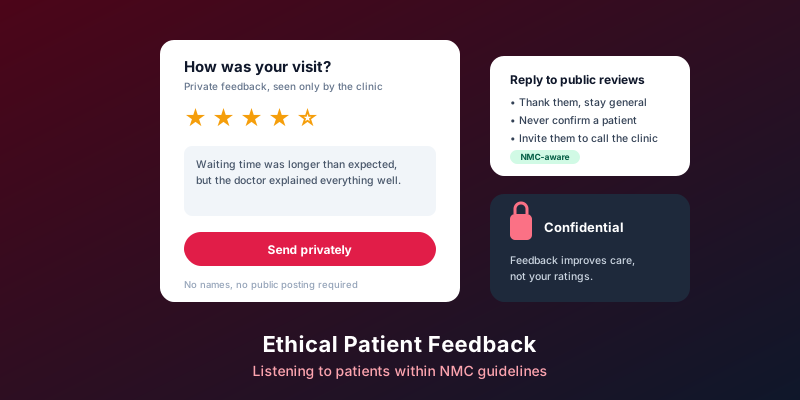
Explanation V is unambiguous: no RMP or hospital may solicit, purchase, procure, manipulate, or cause to be published patient reviews, ratings, testimonials, endorsements, or recommendations for promotional purposes. An RMP "shall not request or share patient testimonials, recommendations, endorsements or reviews for professional promotion on social media" — full stop. This isn't limited to fake or paid reviews; asking a genuinely satisfied patient to leave a Google review for promotional purposes is now covered by the same prohibition.
- × Superlative and unverifiable claims — "Guaranteed cures," "Best doctors," "No.1 Specialist," "100% success," "Painless treatment," "Miracle treatment," or any similarly exaggerated assertion about personal achievements or success rates.
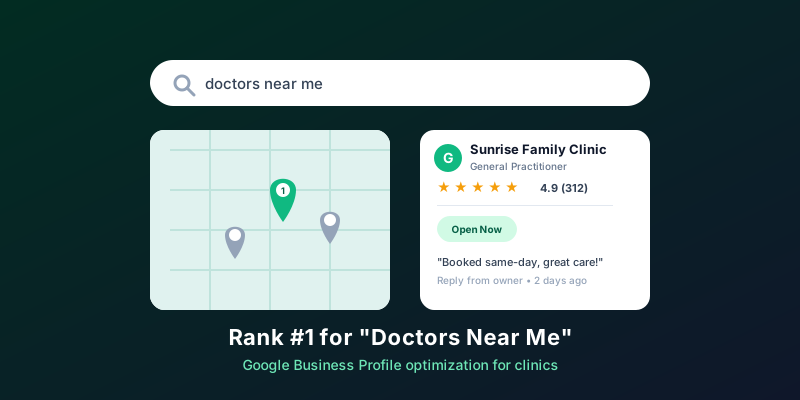
- × Comparative superiority claims — "best," "No.1," "leading," "most trusted," "top," "unmatched," unless the claim is objectively verifiable, based on a transparent and independently ascertainable methodology, with the award, ranking, methodology, date, and awarding organization disclosed. A self-reported "Rank #1 on Google" does not meet this bar.
- × Discounts and inducements — coupons, cashbacks, limited-period offers, free procedures, referral benefits, or "similar inducements" that could encourage unnecessary consultations, diagnostics, or treatment. A birthday-message discount on a "wellness package" falls squarely in this category.
- × Before-and-after photos, celebrity patients, and promotional case stories — permitted only when published strictly for scientific or educational purposes with anonymized patient consent.
- × Lead-generation fees — no commission, rebate, bonus, gift, or lead-generation fee tied to the referral or procurement of patients. Marketing agency, influencer, or platform contracts cannot be structured so payment depends on patient volume referred.
- × Paid or manipulated rankings — procuring fake followers, likes, reviews, or manipulating search rankings, visibility, or algorithms to create a misleading impression of professional standing. Platforms hosting RMPs must themselves ensure no "paid ranking of doctors."
- × Undisclosed AI-generated promotional content — any compliant AI-generated promotional content must carry a source mark disclosing its AI origin. AI may never be used to manipulate a patient's image, voice, or testimonial, or to fabricate a synthetic endorsement.
- × Use of an RMP's own photo or image for self-advertisement, including on a consulting room's letterhead or signboard where it functions as publicity material.
What's Still Allowed
The guidelines aren't a blanket ban on being found online — they draw a clear line between factual information and promotion. The following remain permitted:
Factual institutional information
Name, location, contact details, departments, facilities, equipment, services, emergency services, accreditation status, and applicable charges — as long as it stays objective and verifiable.
A patient-information doctor directory
A hospital website listing its doctors' names, qualifications, specialties, registration details, and availability is "materially distinct" from a paid or promotional advertisement.
Formal practice announcements
Starting a practice, changing address or practice type, temporary absence, resuming practice, succeeding another practice, or a public declaration of consultation fees.
Research and public-health education
Published case studies in reputed medical journals, public-health lectures in an RMP's own name, and general health education pamphlets that make no cure or superiority claims.
Campaigns run on Government of India or state government health programmes, in the larger public interest, are explicitly exempted from the guidelines altogether.
Patient Privacy, Separately Enforced
Chapter I also tightens patient-data handling for advertising purposes: photographs, videos, records, and testimonials can't be used for promotion without legally compliant consent, and that consent must be specific, informed, voluntary, documented, and verifiable. Critically, patient consent alone does not make an otherwise-prohibited testimonial, before-and-after depiction, or success story permissible — the underlying practice still has to be allowed under the guidelines in the first place.
Penalties: Graded, Not One-Size-Fits-All
Enforcement runs through the concerned State Medical Council, with a show-cause notice required before any penalty, and a reasoned, speaking order explaining the violation and the basis for the penalty. The guidelines set out a graded escalation:
An RMP aggrieved by a State Medical Council's findings can appeal to the Ethics & Medical Registration Board, NMC, within 60 days, with a further second appeal available within 60 days of that decision.
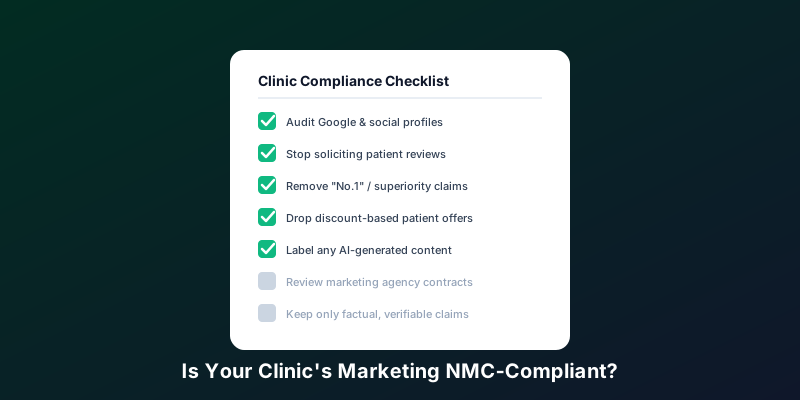
This notice came into force immediately, which means any clinic actively running review-request campaigns, discount-based patient outreach, or unverified "top-ranked" marketing claims is already operating outside these rules, not preparing to be. The practical next step is a full audit of every channel — Google Business Profile, WhatsApp, social media, and any third-party marketing contracts — against this list.
Frequently Asked Questions
Do these guidelines apply to clinics, or only individual doctors?
Both. The guidelines separately address Registered Medical Practitioners and Hospitals/Medical Institutions/Clinical Establishments, with largely parallel restrictions for each, and clarify that using a digital platform or third party doesn't shift responsibility away from either.
Can a clinic still respond to Google reviews it didn't ask for?
The guidelines target solicitation, fabrication, and manipulation of reviews for promotional purposes — they don't address organically received reviews a clinic didn't request. Responding professionally to reviews that arrive unprompted falls outside the specific prohibitions listed.
Is a hospital's "Meet Our Doctors" directory page now against the rules?
No — the guidelines explicitly state that a hospital website directory listing doctors' names, qualifications, specialties, registration details, and availability serves a patient-information function and is materially distinct from a paid or promotional advertisement.
Does this ban AI tools in clinic marketing entirely?
Not entirely. AI-generated promotional content for commercial interest is prohibited, but AI-generated or AI-assisted content that otherwise complies with the guidelines is permitted as long as it carries a clear source mark disclosing that it is AI-generated.
What should a clinic do first to get compliant?
Audit every active channel — Google Business Profile, WhatsApp campaigns, social media, website claims, and any marketing agency contracts — against the prohibited-practices list, and remove or revise anything involving review solicitation, discounts, superlative claims, or lead-based agency fees first, since those map directly onto the "serious violation" category.