Many clinics now take some consultations by phone, video or chat, often informally: a follow-up on WhatsApp, a call about a lab report, a quick video check for an elderly patient. India has had formal rules for this since 2020. This post turns the Telemedicine Practice Guidelines into a routine you and your staff can follow every day.
Please note: this is an operational summary, not legal or clinical advice. The guidelines and their medicine lists can be revised. Check the current version published by the National Medical Commission and the Ministry of Health and Family Welfare before changing how you practise.
Which Rules Apply
The Telemedicine Practice Guidelines were issued on 25 March 2020 as Appendix 5 to the Indian Medical Council (Professional Conduct, Etiquette and Ethics) Regulations, 2002. They apply to Registered Medical Practitioners (RMPs) enrolled in a State Medical Register or the national register, and they cover consultations by video, audio and text, including messaging apps and email.
The core principle is simple: a teleconsultation follows the same professional and ethical standards as an in-person visit. The medium changes, but your responsibility for the patient does not. The guidelines also say you should not insist on a teleconsultation when a patient wants to be seen in person.
Before the Call: Identity, Consent and Mode
Know who you are talking to
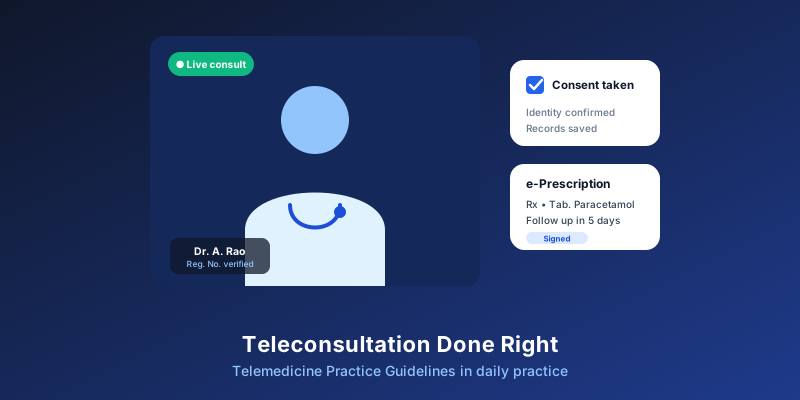
Anonymous teleconsultation is not allowed. Confirm the patient’s name, age and contact details, and if a family member is speaking for them, note who it is and their relationship. Equally, the patient should know who you are: introduce yourself with your name and qualifications.
Record consent
If the patient starts the teleconsultation, consent is treated as implied. If the clinic, a health worker or a caregiver starts it, you need explicit consent, which can be given by message, email or on the call itself. Either way, write it in the patient’s record. A single line in the visit note, such as "Teleconsultation by video, patient-initiated", is enough to show the basis.
Pick the right mode
Text works for sharing reports and simple follow-ups. Audio adds tone and lets you ask questions. Video lets you see the patient, and some prescribing is only permitted after a video consultation. Choose the mode the situation needs, not the one that is quickest for the clinic.
First Consultation or Follow-Up?
The guidelines treat first consultations and follow-ups differently, and the distinction changes what you can prescribe. Broadly, a consultation counts as a follow-up only when it continues care for the same condition after a recent in-person consultation with the same doctor, within six months. A patient you have never seen, one you last saw more than six months ago, or one presenting with a new complaint is treated as a first consultation.
Train your front desk to ask two questions when booking a remote consultation: "When did the doctor last see you in person?" and "Is this about the same problem?" Recording the answers at booking saves time on the call.
Prescribing Within the Medicine Lists
The guidelines sort medicines into lists that control what may be prescribed remotely:
- List O: medicines considered safe to prescribe through any mode, largely over-the-counter products and those notified for public health emergencies.
- List A: medicines that may be prescribed at a first consultation only if it is by video, and re-prescribed at follow-up.
- List B: medicines that may be added at a follow-up for a condition already diagnosed at an in-person visit.
- Prohibited: medicines that cannot be prescribed by teleconsultation at all, including those in Schedule X of the Drugs and Cosmetics Rules and narcotic and psychotropic substances under the NDPS Act.
The lists can be updated by notification, so keep a copy of the current version where every doctor in the clinic can find it, and check it periodically rather than relying on memory.
Knowing When to Stop and See the Patient
The guidelines leave the most important judgement to you. If you cannot reach a sound assessment without a physical examination, you should not prescribe until one can be arranged. In an emergency, you may give advice to the best of your judgement, but the patient must be directed to in-person care straight away.
Make this easy in practice. Agree in advance which nearby facility you refer emergencies to, keep its number on the desk, and give staff a clear script for converting a call into an in-person appointment the same day. Either the doctor or the patient can end a teleconsultation at any point.
Records, Prescriptions and Privacy
- Keep the trail. Retain call logs, chat and email records, images and reports the patient shared, and your notes, just as you would for an in-person visit.
- Issue a proper prescription. The patient should receive a signed prescription, and your registration number must be displayed on prescriptions, receipts and electronic communications.
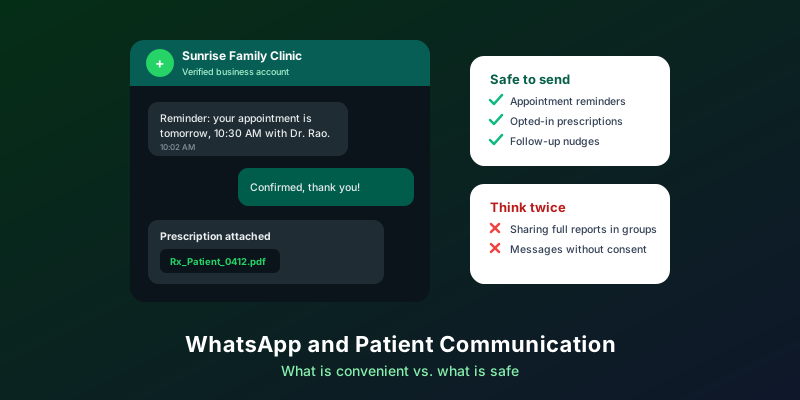
- Send to a pharmacy only with consent. A prescription can go directly to a pharmacy only if the patient explicitly agrees.
- Protect the data. Teleconsultations generate photos, voice notes and reports on phones. Personal data rules apply to all of it; our guide to DPDP consent for clinics covers the basics.
The guidelines also say AI tools may support a doctor but cannot counsel patients or prescribe on their own. The final decision stays with the RMP.
A Teleconsultation Routine for Your Clinic
- Book remote consultations into the same calendar as in-person visits, so nothing happens off the record.
- At booking, record the patient’s identity, the last in-person visit date and the reason for the call.
- At the start of the call, introduce yourself and confirm the patient’s identity.
- Note the mode and the consent basis in the visit record.
- Check the medicine lists before prescribing, and convert to an in-person visit when in doubt.
- Send a prescription that carries your registration number, and file the visit with the patient’s history.
MedHive Pro already handles the calendar, patient history and digital prescriptions shared on WhatsApp. Built-in video consultations are on the roadmap rather than live today: the video consultations page explains the plan and offers early access. If you consult from your phone, our post on EMR on mobile covers what to expect.
Frequently Asked Questions
Is a WhatsApp chat with a patient a teleconsultation?
If you give medical advice or prescribe, the guidelines treat it as one, whatever app you use. That means the same identity, consent and record-keeping steps apply.
Can a nurse or assistant run the call?
Staff can set up the call and collect details, but the consultation and any prescription must come from the registered doctor. Check the guidelines’ provisions on health workers if your clinic uses them in remote care.
Do these rules apply to dentists or AYUSH practitioners?
The 2020 guidelines are written for RMPs under the medical council framework. Dental and AYUSH practitioners should check the guidance issued by their own regulators.
Keep Remote Visits on the Record
Put every consultation, in person or remote, on one calendar and one patient history with MedHive Pro.